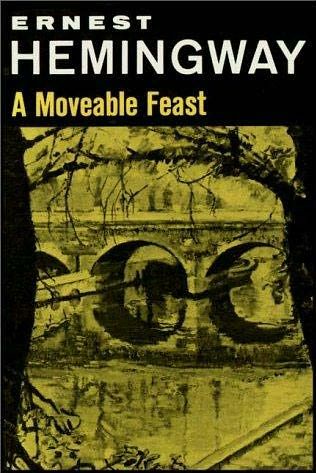
I decided to finally read Hemingway's memoirs of being a young writer in Paris in the Twenties after getting my DVD of Midnight in Paris recently. I'd been meaning to read it for a number of years, but I just kept putting it off because I've read a couple of his novels and I really don't like his writing style.
Hemingway wrote in simple sentences.
And this book is no exception.
Hemingway hated adjectives.
And descriptions.
He wrote to show you people, events and places. Not to tell you of them.
He was also very much a man's man.
However, I liked A Moveable Feast and you have to read it.
It's a fascinating memoir of how Hemingway was training himself to be a great writer by living in a small flat with his first wife and child, struggling to get by and yet still making himself write all day and every day in order to publish stories here and there.
You really get a taste of what Paris must have been like during the heyday of the Lost Generation of writers and artists that had gathered in Paris.
And there are also the stories he tells of the famous people that he was friends with. There are tales of him drinking with people like Ford Maddox Ford and Ezra Pound and borrowing books from Sylvia Beach's Shakespeare & Co. His and everyone else's hero-worship of James Joyce and a great chapter on how much Gertude Stein's lectures and advice meant to everyone. But the saddest story of them all are the chapters about his friendship with Scott Fitzgerald and how his drinking affected him, which is worth reading the entire book just to get to.
I wish that more Lost Generation writers had written memoirs about the Twenties in Paris. It was a truly a Golden Age and a unique period of creativity and a wonderful times to be alive and I'm sorry I missed it but I know that we must live in the present and visit the past through the texts that they left behind.
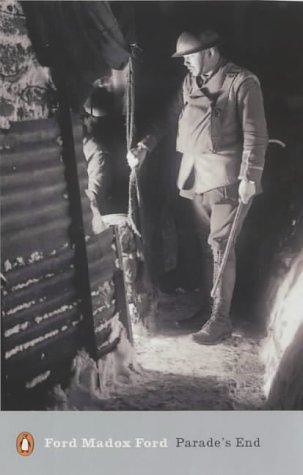
A couple of years ago I took the interwar lit course at uni and it's topic was The Great War and Shell Shock. The professor devoted a full month to discussing Parade's End by Ford Maddox Ford, which no one had ever heard of before. It has never been out of print but it has never been a best-seller. But it has been hailed as one of the greatest English novels of the Twentieth Century, which I would have to agree with.
Parade's End is actually four novels, published separately but meant to be read as one volume. They are:
Some Do Not... (1924)
No More Parades (1925)
A Man Could Stand Up (1926)
Last Post (1928)
I have struggled since I began this blog to write a post about this novel since I began this blog. It's just so hard to put the plot and what the author is saying into words. So, here goes.
Parade's End chronicles the life of Christopher Tietjens from his life just before the outbreak of the war, to his service on the Western Front and his life after he returns and tries to find his place in a society that has no need for his character and what it stands for.
Tietjens is "the last Tory". And by Tory, I don't mean a member of the Conservative Party, I mean a Tory as opposed to a Whig. Just look it up, it's to hard to explain succinctly. Tietjens is a brilliant government numbers man, a member of the landed gentry, an officer and a gentleman and the last Edwardian. Or at least he was before 1914. After the war he is still the same man, but the problem that he faces is that the Twentieth Century started while he was serving at the Front and by the time 1918 roles around and he returns from France, everyone who acted like him and held his values had either been killed or were too old to have a meaningful place in society. For Tietjens, the Twentieth Century is embodied in the two women in his life. His bitch of a wife Sylvia, a vindictive and sadistic socialite who is determine to ruin both him and his entire family history and Valentine, a high-spirited modern woman and a suffragette whom he meets during the war and whom he lives with after the war in an unconsummated relationship.
In the book, Ford wrote that the effect of the First World War was "a crack across the tabletop of history". And in a sense, it was. It ripped an entire society from the stagnate past and thrust it into the modern world in the space of just four years. Nothing would ever be the same and this was the message that Tietjens finally begins to understand by the end of the book.
But what is the book about? Well, that's rather hard to explain. To begin with, Ford began writing it during the war, but didn't finish it until ten years after. The plot is hard to explain because Ford is one of the first writers to employ that oh so modernist method of time skips. The narrative, like memory itself, jumps around from different times and places and it is only at the end that we finally get the full picture of just how much being in the war had affected Tietjens.
Parade's End is about trying to capture and explain the world that Tietjens comes from, the world that was lost so suddenly in 1914. In a nutshell, Parade's End is about the end of an epoch and it is an attempt to recapture what was lost: lost time; lost friends; the loss of a generation of young men; the magic of the past; the ending of parades; the end of the natural officer class; and the end of a way of life.
Remember the last episode of Blackadder Goes Forth? That is what this book is about. It is about those officers who went Over The Top and survived and came back to discover that after the most horrific experience in human history (up to that point) they had no place in society.
I wouldn't say that I liked my experience of reading Parade's End. I didn't enjoy reading it, but I was engrossed by it. You have to read it in order to understand fully the effect that the Great War had, not only on those who lived through it, but more importantly, the affect that it had (and still has) on those who came after it and on the modern world itself. For without the First World War, there would be no modern world.
Because it is so long and has no linear narrative, Parade's End would be almost impossible to adapt to television (it could never be a movie) without losing the development of it's characters and Ford's message. Or at least that's what I and everyone in my class thought so when we were reading it. However, the BBC has adapted it into five episodes for broadcast later on this year and have cast Benedict Cumberbatch (the most awesome real name ever!) as Christopher Tietjens. I think he will be perfect in the role. There is only one production still at the moment, but I shall post the trailer and air dates as soon as they are released. But I do highly recommend reading the book before it airs. You have plenty of time to do so. Tell me what you think of it.
Are you ready for the classic tale of world travel and high adventure?
Of course you are!
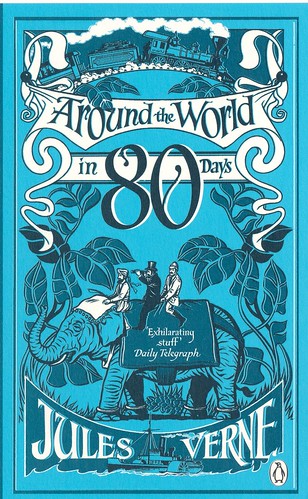
And of course you've heard of M. Verne's famous travelogue, being that you are interesting, intelligent people. Perhaps you've even read it. How could anyone not have heard of Phileas Fogg and Passepartout's famous journey?
If you've never read it, then let me tell you -it's way better than any film version.
If by some bizarre twist of fate and you've never heard of this 1873 novel before, let me briefly tell you about it.
On the night of 2 October 1872, Phileas Fogg, the most punctual gentleman in London and mysteriously wealthy (as people from mysterious backgrounds usually are) is playing whist at the Reform Club (as he does every night) gets into a debate with his friends over world travel and makes a wager of £ 20,000 (about £ 1.3 million today) that he can travel around the world in eighty days or less. Shoving a couple of shirts and £ 20,000 in cash (English pounds were like having a Visa card, accepted everywhere) and dragging poor Passepartout along, he immediately sets off for Dover. What follows next is an exhilarating tale of ship wrecks, missed connections, drunkenness, elephants, mistaken identities, Cowboys and Indians, bribes, mutiny, Japanese circuses and of course train travel. However, there is no hot air balloon scene, that comes from the film. He even manages (or rather Passepartout does) to rescue the beautiful Princess Auoda from certain death in the Indian jungle and fall in love with her.
Does he manage to make it back in time?
Of course he does. After all, his honour is at stake, not to mention the money.
But point of the book is not the final outcome of Fogg's travels. It's the journey itself.
M. Verne wrote the book because it was finally possible to travel around the world as a tourist. Just think, within the space of three years before the book was published, the Suez Canal was created, the Americans finished their transcontinental railroad and all of the railways in India were finally linked up. This was the beginning of the tourism industry as we know it today and Around the World in 80 Days is the greatest travelogue ever written, fictional or otherwise.
For some reason this book has never been taken seriously. It is seen as just a Boys' Own adventure story rather than as a real novel with complex characters. We never hear Fogg's thoughts, we just know his character. We know what Passepartout is thinking and we learn bits and pieces of his life story throughout. Auoda is shown to be an intelligent and independent woman. After all, she was educated in Europe, which is why Fogg decided to rescue her and she can play whist. We are even shown poor Detective Fix's thoughts. But we never know much about Fogg, which makes him so interesting a character and the fact that he is the one character who has been completely altered by the journey. Yet for some reason there has never been a critical edition or a proper translation of the book. There aren't even any academic articles on the book, and there are articles on everything in literature that you could possibly think of.
Why do I love this book so much?
Because it's so much fun to read and imagine yourself right there with Fogg, Passepartout and Auoda.
Of course the 1956 film is the most famous adaptation, it did win Best Picture after all and it is littered with famous cameos. Around the World in 80 Days is not that true an adaptation, since Michael Todd made it as a grand spectacle and filmed it entirely on location. I found Cantinflas as Passepartout annoying after the first hour and didn't like that the film seemed to focus on him. Shirley MacLaine is clearly miscast as Auoda, you can see her makeup melting. However, David Niven is absolutely perfect as Fogg. David Niven is Phileas Fogg because he's David Niven and no one else but David Niven could play the character as M. Verne wrote it.
There is also the 1989 three part television version, starring Pierce Brosnan as Fogg, even though he's clearly too young to play him. Like the 1956 film, this one also adds bits that weren't in the book in order to make it more visually thrilling. However, Eric Idle is perfect as Passepartout and Peter Ustinov is brilliant as Detective Fix and I loved Henry Gibson's cameo as the conductor. Even though Pierce Brosnan is great at Fogg, I would have preferred to have seen David Niven as Fogg because he's perfect as the character. But I do recommend that you watch this version since you've probably never heard of it.
Michael Palin's travel programme (shot in 1988) is my favourite version. It's also the closest to the book. What makes this version the best (I'm saying it's the best, you can argue with me if you want) is that he's not only following in the footsteps of Fogg, but he's doing it more than 100 years after Fogg, using only surface transport and proving not only is it still just as difficult to travel the around in 80 days, but that if you choose to take up Fogg's wager, you too can have the same sort of adventures that he had.
Michael Palin is right when he says in the opening episode that we travel nowadays more than humans have ever travelled before, but we are seeing less and less of the world thanks to the "conveniences" of modern air travel. And that's what make undertaking a journey such as this so wonderful. It's a way of seeing this rapidly shrinking world for the truly vast beauty that it is.
Is it still possible to travel around the world in 80 days just by using surface transport?
I don't know, but I hope it is.
If you would like me to undertake this experiment, I will accept any donations, however large, through my PayPal account.
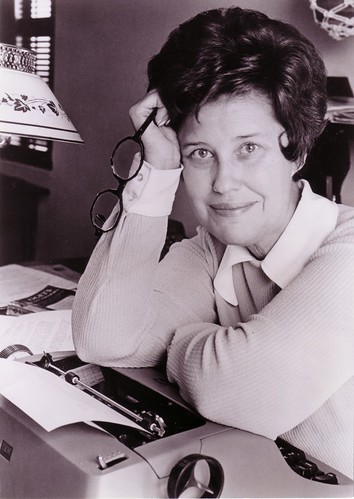
I have always loved reading humourists. I actually want to be a humourist when I grow up. Since this is suburban month, I thought I would write a little something about Erma Bombeck, who is the first humourist I ever read, mostly because I could reach her books on the self.
Mrs. Bombeck wrote over 4000 columns twice weekly between 1965 and her death in 1996 and at one time they were read by thirty million readers in 900 newspapers just in the States alone. Remember when there used to be over 900 newspapers?
Mrs. Bombeck wrote about raising kids (particularly teenagers in the Sixties and Seventies) in the suburban midwest. Or in other words, what the majority of those thirty million readers were doing. So, why was she so popular? Well, her writing is very funny. Even more funny when you see that she is just writing about real life and what happens every day. What she does not attempt to do is to pretend that Leave It To Beaver is a reality show about the average suburban family. Her columns are about the average American suburban family (I would assume). And what made her readable is that she had talent. Most of her writing is very wry and amusing, some of it is laugh out loud funny and sometimes her words are tinged with sadness as she realizes that someday her kids wont be around to fight with everyday.
But if you want to read about what life was like for a housewife in the Sixties and Seventies, do please read Mrs. Bombeck.
She also wrote fifteen books, most of which were instant best sellers. Here is a small list of her best books:
At Wit's End (1967)
Just Wait Until You Have Children of Your Own (1971)
The Grass is Always Greener Over the Septic Tank (1974)
If Life is a Bowl of Cherries, What Am I Doing in the Pits? (1978)
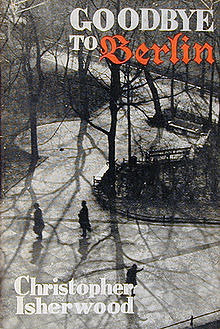
I have read Goodbye to Berlin several times and each time that I read it, I'm always struck by the profound sense of sadness that permeates Isherwood's narrative. Amid his tales of the Nowaks, Landauers, Sally Bowles and the eccentric tenants of his landlady's house and his observations of gay night clubs and Communist meetings is the overwhelming sense of Weimar Berliners being lost in the present and being unable to bare the thought of what the future holds. Throughout the book, Isherwood the narrator hints that the future of Berlin will be dark and will suddenly change overnight (which it did in 1933 and this was published in 1939). But throughout his interactions with the characters, one can see that Berliners chose to ignore the inevitable future of the terms of the Treaty of Versailles holding out for only so long under an unstable government and instead turned towards living in an excessive, voluptuous panic of a sin city in the present. Even the characters who saw the danger posed by that failed hack artist in Munich chose to ignore what would come because Berliners were more concerned with doing whatever was necessary in order to eat and pay this week's rent. Isherwood is a keen observer and recorder of the general feeling and atmosphere of post-war Berlin, but he is an even better recorder of the wide spectrum of the city's populous during a time which will never and could never be repeated.
Out of all the characters that Isherwood encounters, the most famous and the most interesting is Sally Bowles. She is the embodiment of the Lost Generation. The female version of Jay Gatsby, if you will. And yes, Liza's performance in Cabaret is accurate in terms of capturing her personality for all of her faults. What makes Sally so fascinating is that she's living for today, in her velvet shoes and green nails, but she is always so sad since she had no concern for the future. I suppose that's what makes Sally so interesting to read and to meet a Sally in real life; she is fun to be around and you never know what she might think of next, but you can't stay around her forever since she keeps repeating her mistakes.
From the heights of the wealthy merchants to the debts of the working class families, and the artists and performers in between, Isherwood travelled seamlessly through them all as the young Englishman abroad and faithfully (more or less) tells of the characters that he met during his years working and living in Berlin. What he left us was a highly readable primary source of what it was like to live in Berlin in the days before it changed and with it, the world was changed.
At times, the narrative is funny, shocking and we wish to know more about what happened to the characters. But through it all is there is the sense of sadness that seeps through the characters words as we read it knowing that this lively city cannot last and we know what will happen all too soon. But it still remains one of the most important books that anyone who wishes to fully understand the twentieth century must read.
Goodbye to Berlin was adapted twice, first as a Code movie I Am A Camera (which I haven't seen but heard that it was terrible) and second as Cabaret, which is a great adaptation and faithfully recreated the flavour of Berlin as best as they good and Liza actually did wear vintage clothing in the film, which she picked out herself.
There was also a fascinating three part documentary series that the CBC did a couple of years ago on inter-war Paris, Shanghai and Berlin called Legendary Sin Cities, which you can "download" or you can buy it from Mr. Amazon
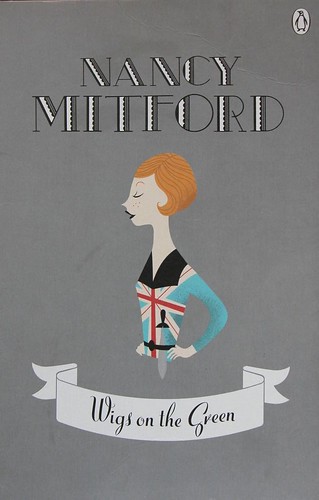
I read this book two months ago and I've been struggling to write a post on it ever since. Actually, I'm never quite sure how to put anything by Nancy Mitford into words on a paper. How can I or anyone summarize and review her works in more then three sentences without ruining the subtlety of her humour and her keen insights into her observations of the human condition, especially since most of her characters are based on her own family?
I could tell you that Wigs on the Green was her third novel and was published in 1935 and has been out of print (for obvious reasons) until just this year. I could also tell you that the book is both a comedy of manners about two young men in search of an heiress to marry and a scathing satire on the British Fascism movement started by Diana's husband and that the character of the heiress Eugenia Malmain is clearly based on Unity. This book is more then just a lampoon of Fascism, like Wodehouse's Spode and the Black Shorts. It is a both a satire and a criticism of Fascism, but also a warning of the very real danger of what people with Unity's level of fervour for the Nazi movement could lead too for Britain.
However, it is also a very funny book. Who else but Nancy would describe the village beauty as being "fluffy" or repeatedly point out that Eugenia is the wealthiest heiress in Britain, but wanders around in a threadbare skirt with no stockings! Or have two men as gold diggers and not the other way round. She is also careful to criticize her class and how the morals and values of her parents generation have led to the behaviour of her own generation, whether that be good or bad is left up to the reader to decide. I don't know what else to say, since I don't want to ruin even the smallest detail for you. So I'll end with by saying that it's a hilarious book, you'll enjoy it and it's quite short and easy to read.
Since it's been out of print for so long, it's never been filmed. But it could be adapted by the right person, but only as a BBC series and not a feature film.
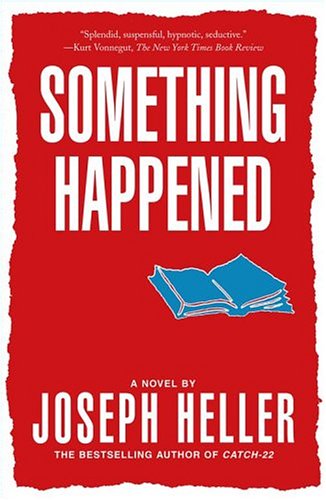
Last fall, I took an American Lit course on the subject of the male mid-life crises in the later half of the 20th Century and this is one of the novels that we read. I thought about doing a post about it then, but I didn't think it was fitting at that point, so instead I wrote my term paper on it.
Given the self-reflection that Don Drapper is going through this season, I think that the time is right to talk about it. Something Happened is Josph Heller's long awaited second novel and it didn't do as well as Catch-22 did. This is mostly because it's very difficult to read, mostly because there is no plot, in a traditional sense.
The entire novel, which is extremely long, is Bob Slocum's reflection on his life, experiences, job, family life and his (negative) opinions of those that he interacts with. Something Happened is basically what Don's life would have been like in ten years had Betty not divorced him. Bob's wife is a bored and not aging very well, his daughter is a teenager and rebelling against everything. His middle son, whom he loves more then anything is quiet, not doing well at school and is terrified of everything and only wants to please his father. Bob is ashamed of his youngest son (the only member of his family that he names) because he has mental problems and hurts Bob's social standing because they can't talk about him in public for fear that the family would be judged.
You may have noticed how dark and sad Don's thoughts are. That is the tone of the entire novel. Bob is afraid of everything, especially of his co-workers, who are in turn afraid of each other. Bob is also afraid of the social changes the are happening in the Seventies, afraid that his wife will discover his numerous affairs, afraid of what his children will grow up to be. Essentially, Bob is afraid of life. The entire novel is about nothing happening until the very end and it is up to you to determine whether Bob is telling himself the truth in the last chapter about how the thing that happened has changed him or if he is just lying to himself.
Something Happened is not an easy or a fun book to read. But you should read it if you want to understand the mind-set of Bob and Don's generation as they enter middle age and the Seventies and how they are dealing with all of the social and cultural changes that happened in the Sixties and how they are coping with the rise of the Baby Boom generation and how they see their role in a rapidly changing society that they can't do anything about because they fear change.
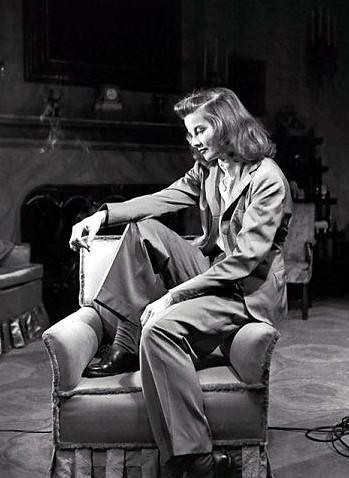
Me: Stories of My Life is Katharine Hepburn's 1991 memoirs. I say memoirs rather then autobiography because it is not an autobiography and she was not the sort of person who would write the traditional autobiography. Her writing is wonderfully straight-forward and delightfully non-linear at times. She even addresses one or two chapters to her favourite houses. Her childhood sounds idyllic and marvelously non-traditional and I love her praise for her parents as she explains how they ensured that she would always be thoroughly independent. KH is also most critical of her early years on the stage, trying to make a go of acting and understanding in retrospect why she kept getting fired and took her years to catch a break.
Now, what about the two aspects about KH's life that people would buy her book for? Well, she doesn't write about every single one of her movies, but she does share any good stories she remembers about making movies and not so much about how they furthered her career or the public's reaction. Besides, you wouldn't like her if she wrote like that. She also tells about her relationships with certain people in the biz, especially George Cukor, Mr. Mayer and Howard Hughes (who she says was almost totally deaf but wouldn't admit it). As to her 27 year romance with Spencer Tracy, after mentioning him throughout the book, she devoted the last section of Me to him. There's no gossip or shocking revelations about their relationship. She doesn't even go into great detail about their romance. Instead she writes about what she thought of him as a person and as an actor and also about the kind of the life that they shared, especially towards the end. I think this style of writing makes his death all the more heart breaking.
I wish that she had written more books. She truly did lead a fascinating life by her own rules and must have been an extraordinary character to know.
Now then children, shall I tell you about Albert Campion? Are you sitting comfortably?
Albert Campion is not a detective, although he does usually solve the crime. Campion is an Universal Aunt and amateur adventurer. He will undertake your case, so long as it is deserving. He is recommended by Important Persons, the police and criminals. Albert Campion is one of his many aliases, but the one he uses most often. He is actually the second son of a viscount and is regarded as the black sheep of the family. He is tall, blond, wears glasses that make him look like an owl, speaks in nonsense most of the time and wears a blank and idiotic expression to hide his intelligence. He is assisted on his adventures by his housekeeper and ex-burglar Lugg.
Margery Allingham wrote 18 novels featuring Campion, but I prefer the more light-hearted pre-War ones. Allingham did not write just your ordinary whodunits and they aren't exactly detective stories either, since the crime is not meant to be solved by the reader. Instead, she wrote mystery-adventure novels, with touches of romance, folklore and truly sinister crimes.
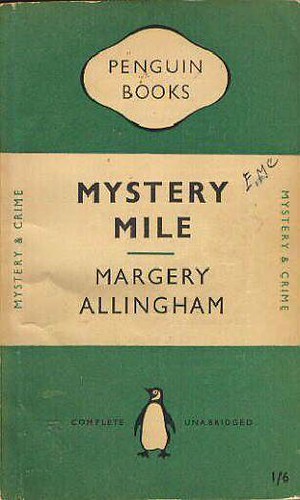
Mystery Mile is about an American judge named Lobbett who is very close to knowing the identity of the mysterious and evil gangster Simister. Simister's men have already tried to kill him four times, but instead killed four of his servants. Marlowe and Isopel are taking their father away from New York, thinking that they could escape. The Lobbetts meet Campion on the boat going over to London and he saves the Judge's life. Once in England, Campion arranges to take the Lobbetts to stay with some friends of his. Giles and Biddy are twins and the owners of the small village of Mystery Mile (isn't that a great name?) which is also an island connected to the mainland by a narrow road. Sounds safe, doesn't it, you could easily spot a stranger approaching. But then the vicar kills himself, the officious shop keeper kidnaps Biddy, a harrowing rescue over the rooftops, a spot of arson and the Judge mysteriously disappears from a maze and his blood-stained clothes turn up later. And what does a red chess piece, a children's book and a valuable painting have to do with the solution? Everything leads up to a final deadly confrontation between Simister (who's identity is easy to figure out once the clue is revealed) and Campion. In a shaky hut. Over a pit of quick sand. At night. And there's some acid involved. It's dashed exciting, I can tell you.
Eight of the Campion novels were adapted into two 50 minute episodes each in 1989-1990. Brian Glover plays Lugg and Peter Davison (the Fifth Doctor and Tristan Farnon on All Creatures) played Albert Campion, who he looks like. They are simply wonderful adaptations filled with beautiful and sometimes eccentric 30's costumes. Campion is available on Regions 1, 2 and 4 and at your local library but not your local video rental store. The Region 1 DVDs are quite expensive (HMV wants $100 for each series) but definitely worth it. Mystery Mile was adapted as the last episode of series 2.
This is the intro to series 1 and that's Peter Davison singing.
Here is a clip from Mystery Mile.
Here is the only other clip I could find, but I forget which episode it's from.
So, have we all seen the gorgeous adaptation by now? The one with David Suchet that is, not the 1978 movie with Peter Ustinov's ridiculous French accent. Beautiful photography and wonderful late-Thirties costumes, wouldn't you agree?
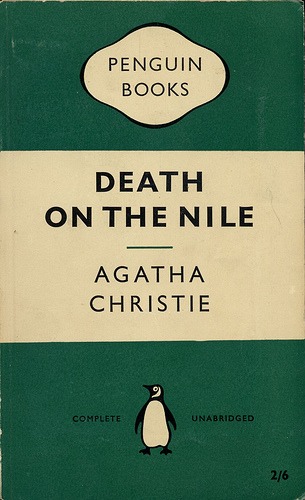
How about the original 1937 book? Well, it took me ages to actually get through it. At one point I got to the middle and Linnet was still alive and I had to put it aside and read several other books before I went back and finished the blasted thing in one go. I've mentioned before that even though I've read a lot of her books, I really can't stand reading Agatha Christie. This book best illustrates why I don't like her. Death on the Nile is really two different books in one. First, there is the melodramatic love triangles between Linnet, Jacqueline and Simon and Cornelia, the Doctor and Ferguson and Cornelia's aunt, who does actually approve of Cornelia's marriage at the end of the book.
The second book is of the murder itself and the subsequent investigation by Poirot and Col. Race. The crime was added in almost as an afterthought, as if Mrs. Christie suddenly remembered that was why people read her books. The crime is ingenious and so very clever. Especially the bit about the nail polish and the sound of a cork popping. What would have happened if no one had heard the popping? And the nail polish is just brilliant. The major reason why I don't like reading Agatha Christie is because she clearly hates Poirot (as anyone who has read Curtain would know). As her popularity rose and she had to write the Poirot series, she increasingly made Poirot unlikeable and more and more like a vain, old, foolish egomaniac. Poirot keeps drifting in an out of the narrative until the murder is commited and when he does appear, Mrs. Christie tells us of what the other characters think of him, which isn't favourable. But it does make you really appreciate what David Suchet has been doing for the past twenty years and I hear that he is determined to finish off the canon. If he does, then he would be the first actor to have filmed every story of a literary detective. Although Jeremy Brett did get close, but that's a post for another day.
The other reason why I don't like reading Agatha Christie is that she's not a very good writer. Her crimes are ingenious and The Murder of Roger Ackroyd is fantastic for it's uniqueness. But her writing style is much more suited for the melodramatic romances she kept clogging up her books with. But she's not much of a detective writer because she lets the reader's suspense go and when she realizes that she's wandered off then she adds another dead body. For great mystery writing, I much prefer Dorothy Sayers.
The adaptation did change a few minor points, but it is largely faithful to the novel, except for the relationship between Tim and his mother. ITV changed it into something weird to get better ratings or for controversy, but in the novel he asks Rosalie to marry him, which is the much better outcome.
But if you only two Agatha Christie books in your life, or you want to see how to adapt a novel into a television show, then read this one and The Murder of Roger Ackroyd.
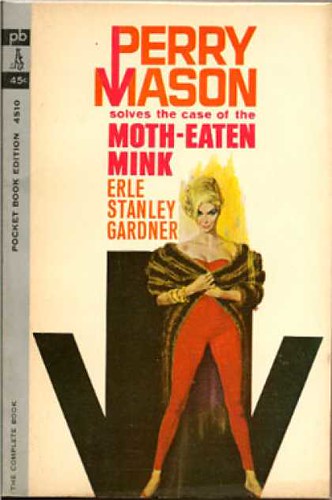
A waitress named Dixie recognizes a customer who wants her dead. She runs out through the kitchen and into the alley where she sees a car driven by some men with guns who would like to give her a ride home and so she turns the other way and is hit by a passing motorist. In her rush to leave the restaurant, Dixie leaves behind her pay cheque and her mink coat. Now, to leave behind a mink coat, you'd have to either be crazy or in a lot of trouble. The restaurant's owner, Morris, knows that she is in a lot of trouble and so he hires one of his regular customers without explaining why he needs a lawyer. That regular customer is Perry Mason, a celebrated criminal lawyer who just happens to solve every case before the cops do and is able to prove the innocence of his client by doing so. Perry Mason is obliged to accept Morris and Dixie as his clients because he loves the steaks that Morris serves and it is so hard to find a good regular restaurant to go to. In the course of investigating, Perry Mason (followed closely by the Homicide Department) along with his secretary Della Street and his permanently retained private detective Paul Drake uncover a large bookmaking operation with a hotel as a front, a pawned engagement ring, a suspected cop killer and a dead bookie. All of which leads to finding out who the real cop killer, most unpleasant.
Erle Stanley Gardner wrote over 80 Perry Mason novels, roughly one every six months for 40 years. Yes, his novels do follow the same basic plot structure, where the characters are introduced, a crime is committed, Perry's client is accused of murder, Perry and his crew investigate, a trial is held and Perry figures out who the real murderer is in a dramatic courtroom coup. But what makes the novels exciting is figuring out whodunit, how Perry figured it out and what the confession will be like. What separates Gardner's work from pulp is his writing style. Everything is written in plainly and very straight forward, however, from the first paragraph to the last, the action never stops and each page is filled with red herrings and plot twists. Even in this book, there is a shocking revelation in the last sentence.
Because Gardner's work was so popular, it's easy to find a copy of this, or any other of his books, like in the dollar bin outside your favourite used bookshop.
This novel was adapted as part of a television series, which I will be writing a post about for tomorrow.
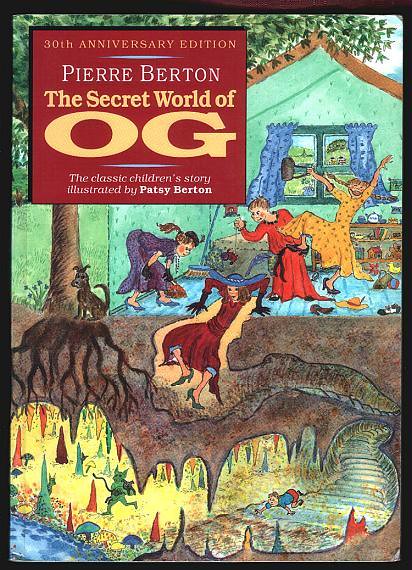
Happy Canada Day! Since this is Canada Day I thought that I had better write about a Canadian book, so why not share my favourite Canadian children's book. I assume that the only Canadian kids book that most of the rest of the world has read is Anne of Green Gables and as much as I like Anne with an "e" (I think it's odd to see anyone named just plain Ann) it was never one of my favourite books. I don't know why, but I just always liked Alice better. Then I was going to do a couple Robert Munsch books, but then I came across this on my shelf. The Secret World of Og was written in 1960 by Pierre Berton, who wrote more than 50 books and popularized Canadian history by making it a fun read. This was his only children's novel and his favourite book.
Og tells the story of four children: Penny, Pamela, Peter and Patsy (based on the author's own children) and of how one afternoon they set off through a trap door in their playhouse, down a tunnel and come upon an underground world filled with mushrooms, populated by mysterious green people who only know the word "og". The people of Og have kidnapped the children's cat Earless Osdick and their baby brother Paul, who is called The Pollywog and both the cat and the baby think that they are dogs. The Ogs have also been stealing the children's toys over the past several months and have placed The Pollywog in their jail. And so the kids must mount a daring rescue plan involving a tube of green paint and some candy and must return to the surface before supper or else they will be caught put in the Og jail too!
I loved this book when I was growing up. I loved it's suspense, it's humour, the adventure and the secret world that lay just a few feet underground and the mysterious creatures who were neither faeries, ogres or gremlins and had I a playhouse, I might have started digging through the floor to see if Og only existed in Ontario or if it was a country wide secret world. I also loved the illustrations by the grown up Patsy Berton, since she was there. Reading it again, I found that part of what made it so appealing was the different personalities of the children and how each one was an equal member of the team and each had their own set of skills which I could identify with. The Secret World of Og is the book that every kid wishes their parent would make up at bedtime because it sets them as the heroes and not a knight or a fairy tale princess.
Before beginning, I should point out that although A Free Soul was a best-seller in 1928, it is now dashed hard to obtain a copy of it. I requested a copy from the library and after several weeks, it finally arrived, from a university library in Utah no less. When I got it I thought "funny, why would the Mormons own a copy of this". After all, the movie is one of the most Pre Code of all Pre Code movies. Norma Shearer has a wild affair with Clark Gable, a violent gambler and Leslie Howard then kills Clark Gable in order to protect Norma Shearer and then he gets away with it. And then I started reading it and I realized that with the exception of Lionel Barrymore's character, the book is wholly different from the movie.
A Free Soul follows the life of Jan Ashe, raised by her father to be a free spirit and to always be honest and independent. Stephen Ashe is a famous criminal lawyer who always takes his daughter with him, whether it be to court or the seedy parts of San Francisco. Stephen is also an alcoholic and racked with guilt because of his reputation of always winning his case, even if he knew that his client was guilty of murder. As a result of caring for her father and hiding his illness, Jan grows up to be a teetotaler. She is also highly intelligent and doesn't care what people think of her frankness or her tomboy wardrobe. She has also known the gambler Ace all of her life and marries him. Ace is not so much of a gambler, rather a very honest man who looks after his family and friends and runs an illegal casino and insists that all of his employees are honest and never act like criminals. Ace is also not violent, preferring to treat those who wrong him with a cold shoulder and cutting off communication, and he is also a teetotaler who refuses to have anything to do with bootlegging. And that is a very brief plot summary since the novel taked place over a number of decades leading up to a sensational trial.
In telling the story of Stephen and Jan, the book could have easily turned into an unreadable melodrama. However, Mrs. St Johns' skills as a writer and keen observer of the human condition make the book not only readable, but also exciting, thrilling and a real page-turner!
She also provides an honest outlook into how people's attitudes changed during the first few decades of the Twentieth Century and how they are divided by class. Mrs. St Johns also uses descriptions of clothing in order define her characters and how they are judged based on their wardrobe. Left out of the film is Jan's preference of wearing shiny brogues. Her shoes are mentioned numerous times, especially during significant events and her brogues symbolize Jan's need for independence and not caring what people think about her. Mrs. St Johns also goes into great detail about Stephen Ashe's growing reliance on alcohol and how it ruined his career and she also shows how much damage his alcoholism does to Jan, who worships her father. If you can find a copy of it, then do read A Free Soul as it provides a greater understanding of urban life during Prohibition from the perspective of a young woman.
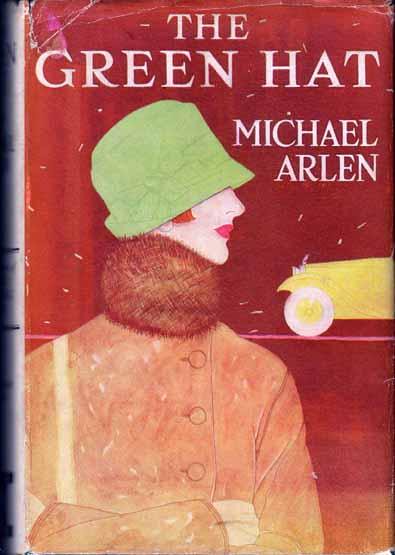
The Green Hat was one of the best-selling novels of 1924 and, due to it's plot, caused a sensation, particularly in America, where some people were shocked by it and naturally told their friends about how shocking it was so that they could go out and read it's shame-making details too. The novel made Michael Arlen an instant literary celebrity for his portrayal of the Bright Young People set way before Evelyn Waugh and others became famous. Yet, given all of this popularity and notoriety, the book and it's author is now largely forgotten.
Set in 1922, the novel is told by an unnamed narrator beginning on the night that he meets the woman in the green hat (which is a very important detail given that no one else wears such an attention-seeking accessory in 1922). She is Iris Storm (isn't that just a marvellous name) who is a member of the upper-class and a wealthy widow, twice over, and only 29. Iris drives a bright yellow roadster everywhere, travels widely and rarely visits England. She is also notorious because her first husband killed himself on their wedding night "for purity" and she is now known as being a "fell woman". Iris meets the Narrator because he lives downstairs from her alcoholic twin brother, once a promising young novelist. Iris and the Narrator talk for hours in his flat and she quite obviously lets her emerald ring drop from her finger when she is vaguely telling him why she has so many affairs. The ring drop shows what kind of a woman she is at the beginning of the novel, which is quite different from who she is at the end (be warned, it's not a happy ending). The events which unfold are told by the Narrator over the next two years as he encounters Iris in London and Paris at important events in her life. Iris invites the Narrator along when something important is going to happen because he is an observer and he thinks that she feels that he understands her character and why she has deliberately chosen such a sad and lonely life.
I decided to read this novel because I had come across it's name and Michael Arlen's briefly in books about the Bright Young People. It's not my new favourite novel and I don't really like it. It's not funny at all, the writing is still a bit amatuerish with a lot of literary references for references sake and also the plot was quite predictable and just so terribly sad. However, it is an important book to read and that is because of Iris. Iris is a glimpse into the start of the Lost Generation. She does live life fast, drives fast and travels in great opulence seeking only pleasure, however she is still tied to Victorian notions because she is doing this in a quasi act of penance for a reason that is understandable but a bit silly. Iris is a very sympathetic character who's life has been decided by circumstances and who wears specific clothes and accessories in order to symbolize her character.
The Green Hat is still being printed and has been loosely adapted into A Woman of Affairs in 1928 with Garbo and Gilbert, but I do think it would make a very good BBC adaptation.
Along with ZaSu Pitts in Greed, Lillian Gish in The Wind, Renée Jeanne Falconetti in The Passion of Joan of Arc and Janet Gaynor in Sunrise, Louise Brooks in her two Pabst films are among the best performances by an actress in silent films. I think a lot of people have seen pictures of Louise Brooks and have never seen her films (of course they aren't that widely available).
When I first read this book, the only one of her films that I'd seen is the library's badly stretched VHS of Pandora's Box and I instantly saw her appeal and her potential for becoming the greatest actress. I think I was reading the Barry Paris biography at the same time, but I felt that I learned more about her by reading her own words. When I was rereading the essays this week, I can't help but want more. The seven essays that Louise Brooks wrote are some of the most marvellous essays that I've ever read. Like Colleen Moore's book, Miss Brooks focused on her life until she retired from acting.
Her essays are extremely witty, very detailed, well-written and highly controlled. We do get a sense of her personality and her motives behind her decision to quit the movies (she said that she hated Hollywood) but she is also very guarded about her life and so she only tells us what she wants us to know. There are seven essays in this book (and as far as I can find out, these are her only published works since she burnt her autobiographical novel) however, only three of them are specifically about herself.
There's her childhood and becoming a Denishawn dancer and a Ziegfeld Girl both while she was a teenager, there's an account of shooting Beggars of Life on location and then her tale of how she walked out on her Paramount contract and went to Europe to make three films.
The other four essays are about people that she knew in the Twenties and her account and more importantly, her analysis of certain events or just their personalities and a record of their method of working. The one that I find most interesting, in terms of film history, is how easily she was able to explain why Miss Gish's star dropped at the same time that Garbo became Garbo.
Louise Brooks was definitely ahead of her time, but she still took the time and care to observe and remember her time and it is her writing which has helped to make her a legend. And perhaps, she is ahead of even our time.
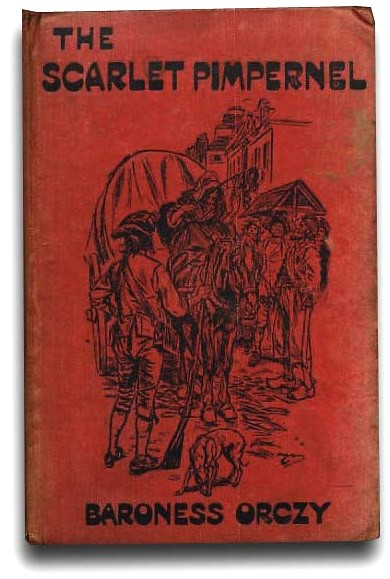
This 1905 blockbuster novel is one of the most thrilling books I've ever read! Apart from being the first superhero story, The Scarlet Pimpernel is full of adventure, passion, suspense, romance, disguises, humour, chases, sword fighting and scrumptious costume descriptions. In other words -something for everyone.
It tells the story of Sir Percy Blakeney, the most well-dressed fop in all of London, who is also secretly the Scarlet Pimpernel, that daring adventurer who saves aristocrats from the welcoming arms of Madame Guillotine during the Reign of Terror. The novel is told from the perspective of Sir Percy's bride Marguerite St. Just, the most beautiful woman in all of Europe with a room full of fabulous dresses. What has made this novel so compelling is that it is almost entirely told by Marguerite, who cannot understand why her husband is cold to her (the reason is miscommunication but neither have been willing to overlook their pride and talk about the incident) and why her brave boyfriend turned into a complete idiot who finds tying his cravat to be the hardest part of his day as soon as they moved to London. Rather than being an airhead or a melodramatic wife prone to fainting spells, Marguerite is a fully developed character with a definite personality and adept at hiding her emotions in public. She is also just as brave as her husband and risks life and limb when she finds out who the Scarlet Pimpernel is.
If you're in need of some adventure on a rainy afternoon, then pick this book up. But be warned, once you pick it up, you can't put it down. This is very much an action-packed story and the event and dialogue just run together and you are compelled to turn the page. Since the novel was an adaptation of the Baroness Orczy's 1903 play, the novel is set up like a movie or a play and everything is evenly paced with no filler. But it is also a passionate romance between the secretive, but devout Sir Percy and the confused but achingly loyal Marguerite and you can't help but scream at the couple for letting their pride get in the way of their relationship. But then again, without this impasse between them, then there would be no mystery for Marguerite to solve, no trap for Sir Percy to walk into and no happy reunion. It is the Baroness' language which really moves the story along and turns this novel from that of potential melodrama to a tale of romance and high adventure. The prose creates many moments that you will remember long after reading it, particularly one at the end of chapter 16 that will make you swoon.
The Scarlet Pimpernel is available to read online here.
There have been countless adaptations of The Scarlet Pimpernel, in addition to numerous parodies; my favourites are the Nob and Nobility episode of Blackadder III and Wayne and Shuster's The Brown Pumpernickel. None of the adaptations are true to the book entirely (the original ending could never be filmed for obvious reasons) but the best adaptation in terms of maintaining the plot and the character of Sir Percy (which could so easily be overdone or not understood entirely) is the 1934 film with the beautiful Merle Oberon and my favourite actor, Leslie Howard. Sink me, it's even in public domain.
I'm assuming that you've all seen the hilarious film version made a year after this book was published, so I hardly need tell you of the plot. But there is more in this book then could be shown in a Code movie. Dashiell Hammett's prose is quick and to the point, jumping along through the plot at breakneck speed without any unnecessary subplots or descriptions in order to pad it out. The novel also gives us more insight and developments into the characters and suspects then the film could have had time to go into, as a result the characters are better developed so that the reasons for the murders and the revelation of the murderer is more exciting in print form.
However, what the book lacks is the banter between Nick and Nora that we loved so much that it spawned five more Nick and Nora and Asta films. And also Nora doesn't drink as much as the film version does, which is a darn shame. Although it would have been nice if Hammett had developed more Nick and Nora detective stories, I don't think I could have imagined then not acting and sounding like William Powell and Myrna Loy and their relationship and detection methods do play out better on the screen then in print and wisecracks are hard to be funny in prose since it removes comic timing and timing is what made the Thin Man series great.
I like the breathless style of Hammett's writing and he's one of my favourite American detective writers. Although he's known for writing hard-boiled detective stories, I don't think that The Thin Man falls into this category because Nick is married to Nora and not sitting alone in his office with a bottle of scotch.
Elinor Glyn was one of the most popular authors before the Crash. Hugely, exceedingly, inordinately popular. Women devoured her books like chocolate. With powerful, modern, and most importantly independent female protagonists in formulaic plots with just a touch of eroticism and a happy ending it's not hard to see why.
Madame Glyn (as she preferred to be called) was also one of the first novelists to see the potential of aligning with the film colony in Hollywood. Anita Loos once quipped "If Hollywood hadn't existed, Elinor Glyn would have had to invent it". Hollywood was a way to further Madame Glyn's method of self-promotion and boosted sales of her books when they were adapted into films (including the recently rediscovered Beyond the Rocks with Swanson and Valentino). Given how much time she spent at San Simeon and Pickfair, she had enormous clout as to deciding whether a person was really a star or not.
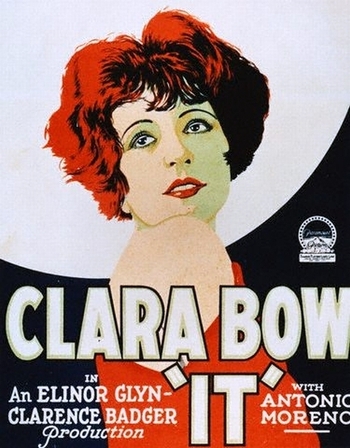
However, her lasting legacy is not for her numerous novels or her personal fame. She created the term "It" for a person that had that extra special something about them (a combination of charisma and sex appeal) and in a major publicity stunt, deemed Clara Bow to be the one and only It Girl and so cemented both of their legacies.
The 1927 novel bares almost no resemblance to the film, but who cares since it is the most widely available Clara Bow film and is just over an hour and has some marvellous costumes. The novel It tells the story of Ava Cleveland, one of the most famous of the New York aristocracy. Ava and her brother Larry are broke but have too much pride (or stupidity) to ask for help. Larry is a nogoodnik bounder, who's addicted to opium, gambling and his Chinese girlfriend Lo Lu, who is also his dealer. Larry is continuously asking his sister for money and because Ava is devoted to her brother and knows nothing about his personal failings, because she is inherently good, will go to great lengths in order to supply it, even failing to pay her enormous dress bill to do so. And so she asks the wealthy, older businessman John Gaunt for a job. John Gaunt is obsessed with "conquering" Ava and gaining power over her and so he creates a job for her in his New York office and one for Larry in San Francisco and bides his time until Larry gets caught and asks for a large sum in order to keep out of jail and Ava will come to him for help. John Gaunt is from the lower class and worked his way up, but he likes to put on airs -going to Savile Row and having the finest and largest apartment in the city. Naturally the jewel in his crown would be to have a wife from one of New York's oldest families. Both John and Ava have "It" and are naturally drawn to each other for that reason and when two "Its" meet they naturally will want to produce a "That". But Ava resists John for the usual reasons and John finds it harder to contain his emotions and so he hires a French decorator to make up a suite for the future Mrs. Gaunt to distract himself until he gets the bright idea to stalk Ava and have his servant spy on her. But everything turns out right in the end with an unusual proposal.
I was surprised at how quickly I read the novel, but I know why. Except for the difference in language, taboos, social conventions and the casual racism, it is the exact same story that you will find if you were to wander into your favourite bookstore and pick up the first Chick Lit book you find. Replace Larry the drug addict with the over barring mother, Ava's past due dress bill with credit card debt, her aristocratic background with a degree from a posh university and being a party girl, and John Gaunt's busy businessman, obsessed with power with... actually he'd probably just stay the same and you have the exact same story and characters that populate today's popular, non literary novels. And they ending would remain the exact same, but with room for a sequel. But at least if you read It, you'll have bragging rights and could read it openly on the bus.
Despite it's popularity, It has not been republished since 1927. I couldn't even find a picture of the original dust jacket online. You will probably find a copy at a university library instead of your local branch, if you can't find it online or at the second hand bookstore. But it does make for a fascinating read if you want to understand what was popular in the Twenties.
My Sister Eileen was originally a series of short stories that were originally published in the New Yorker and collected in this 1938 book, followed by two more books about her life with her sister. The last two stories in this book, the one about the McKenney sisters' first basement apartment in New York with the fungus on the bathroom celling and the subway running three feet below their floor and the last one about the time that the Brazilian navy followed Ruth and Eileen around, were adapted into a Broadway play, two movies, a musical, a radio play and a television series.
The stories themselves are a wonderful account of Ruth and Eileen's childhood in Ohio in the Twenties. The ones that I found most interesting were the accounts of how the sisters and the way that culture changed in America after the war and before prohibition clashed with the strict, puritanical nature of their many aunts and easily shocked neighbours. There's also the beginning story of how Ruth and Eileen would sit through the same movie two or three times in a row in order to see the sex and violence that they missed on the first showing by hiding behind their big round hats.
Being only a few years apart, the sisters were very close growing up and did almost everything together, usually with Ruth deciding what to do and Eileen going along with it. What makes the stories funny (aside from the humourous prose) is the difference between the very pretty Eileen (later to become Mrs. Nathanael West) and the plain, sometimes dumpy Ruth, who had a definite ambition to become a writer. Unlike the adaptations, which focuses on the sisters in New York and their eccentric neighbours, the book focuses on their childhood and how they got into trouble at home, school and summer camp but it also tells the reader the reasons why the sisters would do so many things that got them into trouble.
If you can find the book, then brace yourself for a very funny read that hops along all too quickly.
The 1942 film stars Rosalind Russell as Ruth and Janet Blair as Eileen and is currently in 10 parts on YouTube and will be on TCM on June 2.
The 1955 musical remake stars Betty Garrett as Ruth and Janet Leigh as Eileen along with Jack Lemmon and Bob Fosse. It is not on YouTube and will be on TCM on July 6 and has this rather brilliant dance-off.
Elizabeth Smart's novel written in prose poetry was first published in 1945 and only 2000 copies were printed, but it built up a following until it was reissued in 1966. The novel is a fictionalized account of Miss Smart's on again, off again decades-long affair with the married poet George Barker, with whom she had four children.
By Grand Central Station is a beautiful and heart breaking book. The narrator tells the story of how she met and fell in love with a married man in a lyrical and dream-like stream of conscious style where words and sentences flow across the page. We feel for and understand the narrator as she defies all objects made by strangers and family to her affair and it is understandable why the narrator begins to find pleasure in the suffering that her status as an outcast from society brings her.
The book is so terribly sad, but the use of language is just so beautiful to read that you don't mind the sadness and the pain.
Try to find an edition with the forward by Brigid Brophy and read that first in order to understand the book better. I would recommend reading this book in one sitting, which is easy to do since it's only about a hundred pages and it is a masterpiece.