Showing posts with label silent film. Show all posts

Sunday, October 31, 2010

How To Watch Silent Movies

Buster Keaton

Because I watched The Thief of Bagdad when I was four, it has never occured to me that some may find it difficult to watch silent movies. Sure, we've all watched the occasional silent on fast forward, but who hasn't? Especially when it's overdue. Silent movies, like the Talkies, can range from absolute drek to some of the most exquiset forms of art created in the 20th Century.
The most important thing about the Silents is that they are the only international language. As Norma Desmound said "We had faces!", that is human expressions and actions are truly universal, whether you live in New York, Tokyo or Timbuktu. All you need to do is change the inter titles. Silents gave us the concept of the celebrity and the household name who didn't wear a crown. Just look at the newsreel footage of Mary Pickford and Douglas Fairbanks' honeymoon/publicity tour being mobbed in Soviet Moscow!
So, if you don't live somewhere where you don't have access to a movie palace (and they were palaces) and an orchestra that regularly shows Silents, here are some easy steps to accustom yourself to watching Silents without hitting fast forward:

1. Start by watching a talking picture about silent movies. Singin' in the Rain and Chaplin are both good places to start. So is Mel Brooks' Silent Movie or anything by Guy Maddin.

2. Next, watching documentaries of silent films is very good, as they show clips of important movies. Obviously the best one is Kevin Brownlow's Hollywood: The Pioneers, which has intervies with everyone who made silent films or was in silent films (and Fairbanks Jr. is in there too) who was still alive in the 70's. If you can't find that series, try watching (or downloading) the documentaries that Paul Merton made this year on early fantastical cinema and the silent and early talkies that Hitchcock made in Britain. Mr. Merton also made an absolutely marvelous documentary series called Silent Clowns about Keaton, Chaplin, Harold Lloyd and Laurel & Hardy. There are also a number of biographies of various silent stars, like Louise Brooks and Clara Bow, that are more widely available on DVD.

3. Have you done steps one and two? Are you sitting comfortably? Good. Now we can start watching silent shorts. These comedy shorts are done by masters of their craft (I'm partial to Buster Keaton) and all of them are probabily the funniest things you've seen this month. And a lot of them are available for your viewing pleasure on the internet because of public domain. Yay!!! Try starting with these ones:


4. Now you that you've slowly eased yourself into watching silents, you are ready for the feature presentation. Start with comedies that are just under an hour long and slowly increase the length, while progressing from comedy to more dramatic works. You're choice of comedies is entirely up to personal comedy preference, however if I may, I would like to suggest these non-comedies which are some of the greatest films ever made:
-Sunrise
-Pandora's Box
-Thief of Bagdad
-Nosferatu
-The Cabinet of Dr. Caligari (can't be fast forwarded)
-The Wind
-Metropolis (by a miracle, now in it's complete original form)
-Limelight (the only comedy which will make you cry at the end and shows why Chaplin was a master of pathos an a sheer genius)

There you have it. An easy step by step guide to accustomize yourself to watching Silents. You may not be ready to watch anything by D.W. Griffith or Cecil B. DeMill (people actually died while making his Silents), overly long melodramas, or Erich Von Stoheim's Greed (they've only found a quarter of his nearly 10 hour masterpiece, but I think that it's the greatest film made so far. Citizen Kane is brilliant, but nothing compared to this) but at least you will be able to watch the funniest, saddest, most romantic, tragic and generally some of the most awesome films ever made. I thank you for your time.

Thursday, June 10, 2010

Vintage Books {Lulu in Hollywood}


Along with ZaSu Pitts in Greed, Lillian Gish in The Wind, Renée Jeanne Falconetti in The Passion of Joan of Arc and Janet Gaynor in Sunrise, Louise Brooks in her two Pabst films are among the best performances by an actress in silent films. I think a lot of people have seen pictures of Louise Brooks and have never seen her films (of course they aren't that widely available).
When I first read this book, the only one of her films that I'd seen is the library's badly stretched VHS of Pandora's Box and I instantly saw her appeal and her potential for becoming the greatest actress. I think I was reading the Barry Paris biography at the same time, but I felt that I learned more about her by reading her own words. When I was rereading the essays this week, I can't help but want more. The seven essays that Louise Brooks wrote are some of the most marvellous essays that I've ever read. Like Colleen Moore's book, Miss Brooks focused on her life until she retired from acting.
Her essays are extremely witty, very detailed, well-written and highly controlled. We do get a sense of her personality and her motives behind her decision to quit the movies (she said that she hated Hollywood) but she is also very guarded about her life and so she only tells us what she wants us to know. There are seven essays in this book (and as far as I can find out, these are her only published works since she burnt her autobiographical novel) however, only three of them are specifically about herself.
There's her childhood and becoming a Denishawn dancer and a Ziegfeld Girl both while she was a teenager, there's an account of shooting Beggars of Life on location and then her tale of how she walked out on her Paramount contract and went to Europe to make three films.
The other four essays are about people that she knew in the Twenties and her account and more importantly, her analysis of certain events or just their personalities and a record of their method of working. The one that I find most interesting, in terms of film history, is how easily she was able to explain why Miss Gish's star dropped at the same time that Garbo became Garbo.
Louise Brooks was definitely ahead of her time, but she still took the time and care to observe and remember her time and it is her writing which has helped to make her a legend. And perhaps, she is ahead of even our time.

Thursday, May 13, 2010

Vintage Novels {It}


Elinor Glyn was one of the most popular authors before the Crash. Hugely, exceedingly, inordinately popular. Women devoured her books like chocolate. With powerful, modern, and most importantly independent female protagonists in formulaic plots with just a touch of eroticism and a happy ending it's not hard to see why.
Madame Glyn (as she preferred to be called) was also one of the first novelists to see the potential of aligning with the film colony in Hollywood. Anita Loos once quipped "If Hollywood hadn't existed, Elinor Glyn would have had to invent it". Hollywood was a way to further Madame Glyn's method of self-promotion and boosted sales of her books when they were adapted into films (including the recently rediscovered Beyond the Rocks with Swanson and Valentino). Given how much time she spent at San Simeon and Pickfair, she had enormous clout as to deciding whether a person was really a star or not.
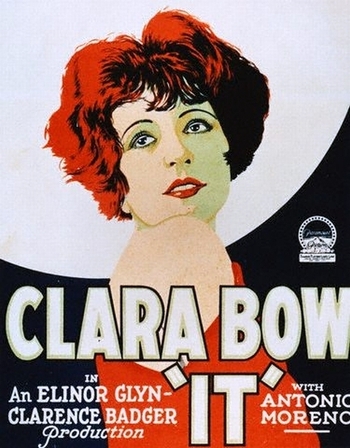
However, her lasting legacy is not for her numerous novels or her personal fame. She created the term "It" for a person that had that extra special something about them (a combination of charisma and sex appeal) and in a major publicity stunt, deemed Clara Bow to be the one and only It Girl and so cemented both of their legacies.
The 1927 novel bares almost no resemblance to the film, but who cares since it is the most widely available Clara Bow film and is just over an hour and has some marvellous costumes. The novel It tells the story of Ava Cleveland, one of the most famous of the New York aristocracy. Ava and her brother Larry are broke but have too much pride (or stupidity) to ask for help. Larry is a nogoodnik bounder, who's addicted to opium, gambling and his Chinese girlfriend Lo Lu, who is also his dealer. Larry is continuously asking his sister for money and because Ava is devoted to her brother and knows nothing about his personal failings, because she is inherently good, will go to great lengths in order to supply it, even failing to pay her enormous dress bill to do so. And so she asks the wealthy, older businessman John Gaunt for a job. John Gaunt is obsessed with "conquering" Ava and gaining power over her and so he creates a job for her in his New York office and one for Larry in San Francisco and bides his time until Larry gets caught and asks for a large sum in order to keep out of jail and Ava will come to him for help. John Gaunt is from the lower class and worked his way up, but he likes to put on airs -going to Savile Row and having the finest and largest apartment in the city. Naturally the jewel in his crown would be to have a wife from one of New York's oldest families. Both John and Ava have "It" and are naturally drawn to each other for that reason and when two "Its" meet they naturally will want to produce a "That". But Ava resists John for the usual reasons and John finds it harder to contain his emotions and so he hires a French decorator to make up a suite for the future Mrs. Gaunt to distract himself until he gets the bright idea to stalk Ava and have his servant spy on her. But everything turns out right in the end with an unusual proposal.
I was surprised at how quickly I read the novel, but I know why. Except for the difference in language, taboos, social conventions and the casual racism, it is the exact same story that you will find if you were to wander into your favourite bookstore and pick up the first Chick Lit book you find. Replace Larry the drug addict with the over barring mother, Ava's past due dress bill with credit card debt, her aristocratic background with a degree from a posh university and being a party girl, and John Gaunt's busy businessman, obsessed with power with... actually he'd probably just stay the same and you have the exact same story and characters that populate today's popular, non literary novels. And they ending would remain the exact same, but with room for a sequel. But at least if you read It, you'll have bragging rights and could read it openly on the bus.
Despite it's popularity, It has not been republished since 1927. I couldn't even find a picture of the original dust jacket online. You will probably find a copy at a university library instead of your local branch, if you can't find it online or at the second hand bookstore. But it does make for a fascinating read if you want to understand what was popular in the Twenties.

Saturday, May 1, 2010

The Complete Metropolis


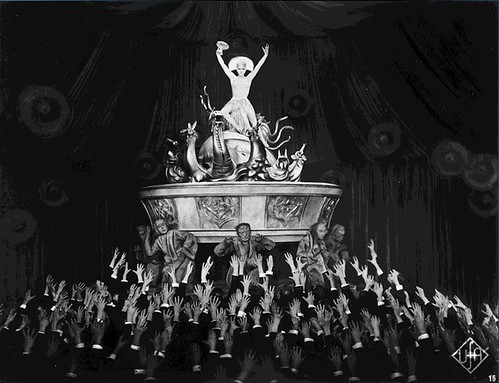
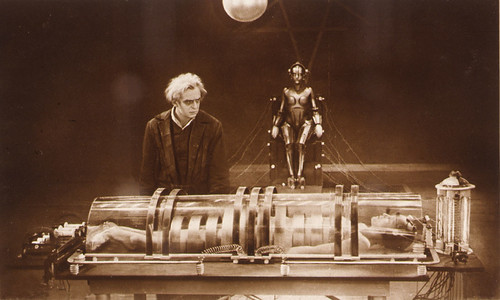
Have you heard? Two years ago the missing 25 minutes of Metropolis, one of the greatest silent films ever, was found in Argentina. That print has now been restored as best it can be by the Murnau Foundation and for the first time since it's premiere in Berlin in 1927, the Metropolis can finally be seen in it's entirety with the original score!!! I haven't been this excited to see a film since... I've never been this excited to see a film! It really is a miracle that the print no one thought existed (the film was cut immediately after it's premiere because a 2.5 hour movie wasn't deemed commercial enough) was found just in time and the technology existed in order to restore it.
Metropolis will be shown at select theatres this summer, and you can check this website regularly to see if it's coming to a cinema near you. And Kino will be releasing it on DVD in November.

Thursday, April 22, 2010

Vintage Books {Silent Star}

Moore148
I was the spark that lit up Flaming Youth, Colleen Moore was the torch. What little things we are to have caused all that trouble
~F. Scott Fitzgerald

I first saw Colleen Moore in a few clips from her films when I was six and she was one of the many stars who were interviewed for Kevin Brownlow's Hollywood documentary. Since then I have watched every one of her films that I could get my hands on, which isn't a lot since sadly many of her films are either lost or not widely available and TCM rarely shows more then a couple of their vast silent film collection every month.
If you can get your hands on her 1968 memoir, then do! It's just wonderful and focuses on her rise in Hollywood to superstar. Miss Moore tells of how she always wanted to be an actress, just like Mary Pickford until when she was fifteen, her uncle made a deal with Mr. Griffith to give her a contract and so she and her grandmother were on the next train to Hollywood. Miss Moore worked hard for six years in forgettable and predictable melodramas and comedies, dreaming of the day when she would become a star. One day she looked at the girls her brother was bringing home from college when she realized what was wrong with her. Her Pickford curls, through popular, didn't suit her boyish body and so her mother chopped her hair off and Miss Moore successfully campaigned for the role that she wanted -the lead in 1923's Flaming Youth, only one reel of which remains. Smash hit and cut to her bob, which wasn't the first but it was the first bob to become world famous and now everyone wanted to be a flapper.
Colleen Moore wasn't the typical wild flapper or flighty young thing, like Misses Bow and Brooks, she kept living a semi-normal life and learned how to invest her money for her retirement. When she did do was observe everything around her and her book details how early feature length films were shots, how studios progressed, what it was like to shoot on location and of the voice coach she had to see after the switch to sound. She also tells of her meetings and friendships with famous people, like the time she found Zelda taking a bath during a party and of the reception for Jean Harlow's second marriage. She also offers her own accounts of the biggest scandals to ever hit Hollywood, taken from either her own experiences or from talking to those involved. She also tells of her struggle with her alcoholic first husband and how much she disliked aspects of her fame, such as her honeymoon in Europe being turned into a giant promotional tour for her latest film and how her clothes were ripped from her back by the crowds waiting to see her. Plus there are some very vivid descriptions of clothes and decorating her own home and how others spent millions building their dream homes. Very little is told about her life after she retired to being a "private" person, expect for the chapter where she tells of how her Fairy Castle came about, how involved everyone got in it and why she toured with it for several years. I'd love to go to Chicago just to see it in the museum.
Miss Moore comes across as a very nice and kind person, the sort of girl you'd like to be friends with, even if she was a big star.
The book as never been reprinted and you'll either have to buy it off of AbeBooks or do what I did. Most public libraries have a service called an Inter Library Loan, which you should be able to find on your library's online catalogue or just ask at the information desk. Just give them the details of the book (Silent Star by Moore, Colleen published in 1968 by Doubleday) and they'll find you a copy from a different library, but be sure to check if your own library has a copy or not. It's well worth the wait (or shipping costs) even if it's just for the dozens of pictures.

This is a clip of her with Harry Langdon in Ella Cinders. The music terrible and wrong, but at least it's shown at the right speed.