Showing posts with label how to. Show all posts

Sunday, October 31, 2010

How To Watch Silent Movies

Buster Keaton

Because I watched The Thief of Bagdad when I was four, it has never occured to me that some may find it difficult to watch silent movies. Sure, we've all watched the occasional silent on fast forward, but who hasn't? Especially when it's overdue. Silent movies, like the Talkies, can range from absolute drek to some of the most exquiset forms of art created in the 20th Century.
The most important thing about the Silents is that they are the only international language. As Norma Desmound said "We had faces!", that is human expressions and actions are truly universal, whether you live in New York, Tokyo or Timbuktu. All you need to do is change the inter titles. Silents gave us the concept of the celebrity and the household name who didn't wear a crown. Just look at the newsreel footage of Mary Pickford and Douglas Fairbanks' honeymoon/publicity tour being mobbed in Soviet Moscow!
So, if you don't live somewhere where you don't have access to a movie palace (and they were palaces) and an orchestra that regularly shows Silents, here are some easy steps to accustom yourself to watching Silents without hitting fast forward:

1. Start by watching a talking picture about silent movies. Singin' in the Rain and Chaplin are both good places to start. So is Mel Brooks' Silent Movie or anything by Guy Maddin.

2. Next, watching documentaries of silent films is very good, as they show clips of important movies. Obviously the best one is Kevin Brownlow's Hollywood: The Pioneers, which has intervies with everyone who made silent films or was in silent films (and Fairbanks Jr. is in there too) who was still alive in the 70's. If you can't find that series, try watching (or downloading) the documentaries that Paul Merton made this year on early fantastical cinema and the silent and early talkies that Hitchcock made in Britain. Mr. Merton also made an absolutely marvelous documentary series called Silent Clowns about Keaton, Chaplin, Harold Lloyd and Laurel & Hardy. There are also a number of biographies of various silent stars, like Louise Brooks and Clara Bow, that are more widely available on DVD.

3. Have you done steps one and two? Are you sitting comfortably? Good. Now we can start watching silent shorts. These comedy shorts are done by masters of their craft (I'm partial to Buster Keaton) and all of them are probabily the funniest things you've seen this month. And a lot of them are available for your viewing pleasure on the internet because of public domain. Yay!!! Try starting with these ones:


4. Now you that you've slowly eased yourself into watching silents, you are ready for the feature presentation. Start with comedies that are just under an hour long and slowly increase the length, while progressing from comedy to more dramatic works. You're choice of comedies is entirely up to personal comedy preference, however if I may, I would like to suggest these non-comedies which are some of the greatest films ever made:
-Sunrise
-Pandora's Box
-Thief of Bagdad
-Nosferatu
-The Cabinet of Dr. Caligari (can't be fast forwarded)
-The Wind
-Metropolis (by a miracle, now in it's complete original form)
-Limelight (the only comedy which will make you cry at the end and shows why Chaplin was a master of pathos an a sheer genius)

There you have it. An easy step by step guide to accustomize yourself to watching Silents. You may not be ready to watch anything by D.W. Griffith or Cecil B. DeMill (people actually died while making his Silents), overly long melodramas, or Erich Von Stoheim's Greed (they've only found a quarter of his nearly 10 hour masterpiece, but I think that it's the greatest film made so far. Citizen Kane is brilliant, but nothing compared to this) but at least you will be able to watch the funniest, saddest, most romantic, tragic and generally some of the most awesome films ever made. I thank you for your time.

Wednesday, May 26, 2010

How to Tie a Scarf #6

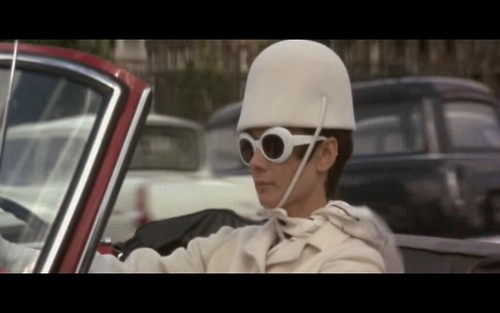
I call this one "The Audrey". It's very elegant and so easy to do, you can do it while standing on the bus. It's also great for preserving your hair style in a sudden wind or rain storm or covering up your curlers.
1. Take a medium or large square scarf. Fold into a triangle and place on head. Take the ends and cross them under your chin.
2. Bring the ends around and tie a double know at the base of the back of the neck.
3. Adjust the front of the scarf so that it is covering your hair, but not your bangs and/or top of the forehead. Put on a pair of large sunglasses and stalk anyone who looks like Cary Grant, Gregory Peck or William Holden.

Tuesday, May 4, 2010

Cinema Tuesdays {How to Steal a Million}

This month's theme for Cinema Tuesdays is Comedy Crime Capers, because if you're going to commit a crime or run from the law you might as well have fun doing it.
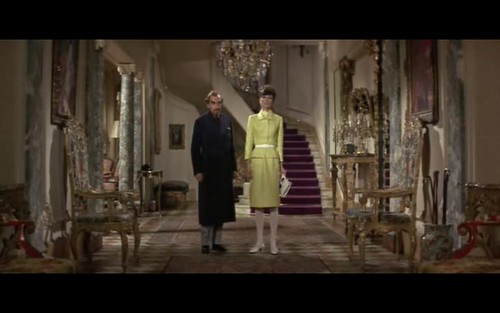
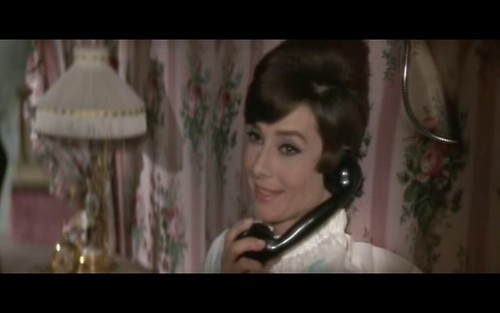
Isn't it amazing how easy it was for AH and Givency to transform from being Cinderella in the Fifties to her cool mod look in the Sixties?
Papa (perfectly played by the very funny Hugh Griffith) continues the Bonnet family business of forging masterpieces and selling them to millionaires with more money than sense.
The Cellini Venus, sculpted by Grandpa and modelled by Grandma, is going on display in a major museum. AH doesn't like this because she is afraid that they will be caught.
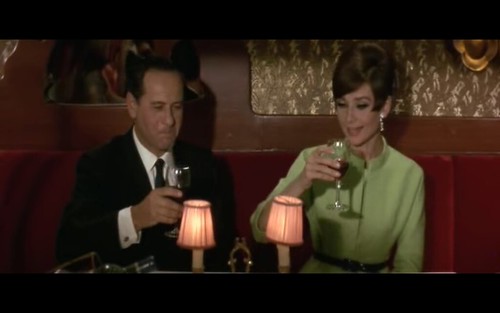
Eli Wallach, playing a rich American tycoon who collects art as a form of relaxation, is determined to get his hands on the Venus -by hook or by crook.
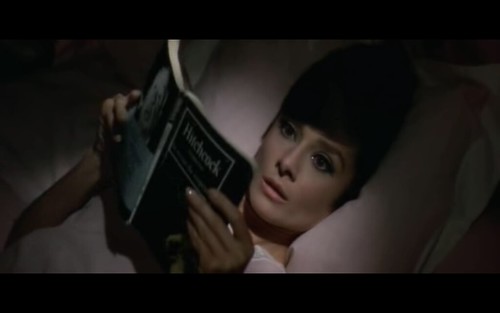
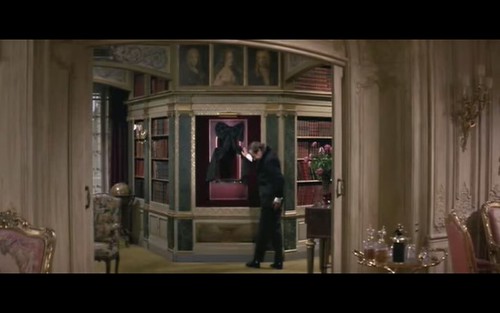
When left alone in the house at night, this is the one author you shouldn't read, especially if you start to hear things that go bump in the night.
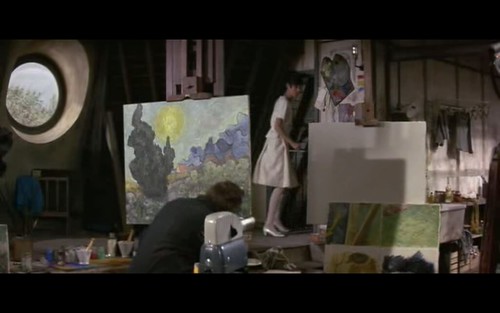
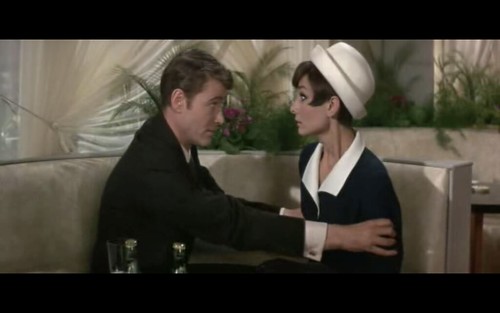
That bump is made by Peter O'Toole, who is trying to steal the Van Gogh. Or is he? Don't you wish that Peter O'Toole had made more comedies in the Sixties, he is rather brilliant at them.
He's also quite right that society burglars don't expect to be shot at while going about their business. The only on the job hazards that society burglars expect to be faced with is keeping their dinner jackets neat.
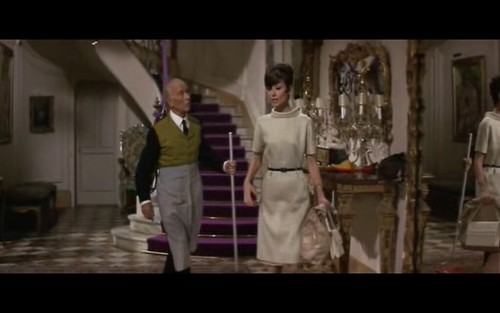
Even in a nightie and rubber boots, she is still more elegant then just about anyone, since she wore the clothes and not the other way round.
Being a society burglar is a nice career choice, it leaves time in the afternoons to wander around museums, getting a cultural education while wearing a three piece suit and inspecting the latest in security measures.
Don't you just hate it when you're stalked by rich Americans who are just after your art collection?
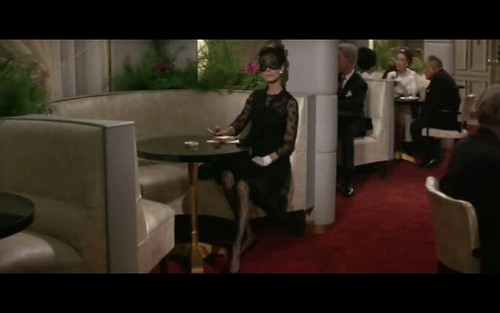
Love the Art Nouveau restaurant.
Unfortunately, the museum is insisting on taking out an insurance policy that involves scientifically checking that the Venus really is 400 years old. Poor Papa will go to jail when they are found out and Givenchy doesn't make prison uniforms.
I'm convinced that tights in the Sixties were just so much cooler than they one's available today.
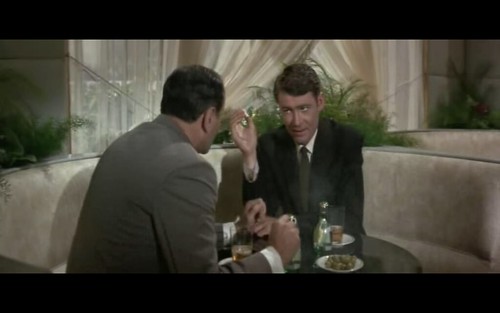
If you're going to plan a robbery with a known criminal, you might as well do it in style.
And before he realizes that Grandma bares a striking resemblance to a certain living person.
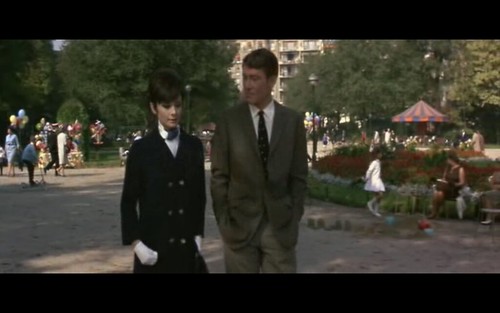
Note to self: when planning to rob a museum, the best way to work out a plan is to walk around Paris snappily dressed.
And don't dressed in the stereotypical burglar attire. Instead wear something simple and elegant, that wont be noticed by the museum security.
I really like how they filmed it in an actual broom closet, instead of just faking the shots.
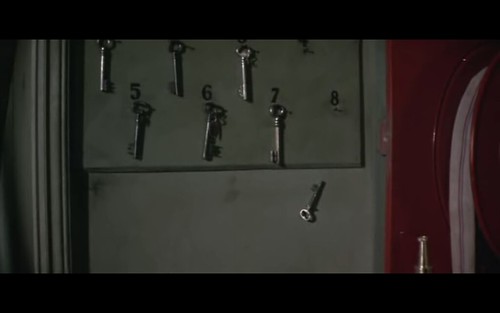
The magic key is my favourite part in the movie.
And the boomerang is so simple and brilliant.
If only it were that easy to steal something now, without having to worry about things like CCTV.
If it weren't for the nice hat, the cleaning woman disguise wouldn't be elegant and frumpy at the same time -a very hard combination to pull off, don't you agree?
I love it when films show the chaos that ensues from normal human reaction.
And her headboard is the only thing I like in the Bonnet house.
Poor Papa! It must be hard to maintain a facade of mourning when the theft is what kept the Venus from being examined and him out of jail.
Of course pawning the statue off to the rich idiot is the natural solution. I wonder how many masterpieces are hidden away in the vaults of the super rich and will never again see the light of day and be enjoyed by the public? That is the real crime, not selling forgeries to millionaires who can afford it.
Such a great suit and a feminine bowler hat.

The only obstacle to our heroes' happiness is Peter O'Toole's confession that he is a private detective specializing in art forgeries and hired by Charles Boyer to investigate the family business.
What will happen to poor Papa?
It's a darn shame when children don't want to take over the family business.


Tuesday, April 6, 2010

Cinema Tuesdays {How To Succeed In Business Without Really Trying}

When I saw the pilot of Mad Men my first thought was "They must have seen How To Succeed In Business Without Really Trying" and then I saw who was playing Bert Cooper:
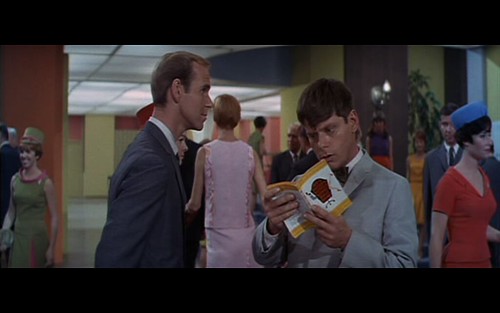
Robert Morse! He starred in both the Broadway show and this 1967 adaptation, which is so much more fun to watch than Mad Men. He plays J. Pierpont Finch, a humble window washer who sees the title book at a news stand. It is an actual book, hard to get a hold of though, but I've read it and the film is a pretty close adaptation of it's self-help tips, some of which can still be used today. So if you can find the book, read it and it might help you on your career.
Following the first step in the book, Finch wanders in through the window to the World Wide Wicket Company, who's slogan "A day without a Wicket is like a day without sunshine" has been around for a hundred years. What exactly is a Wicket? No one really seems to know, which makes it just the right company to start out with.
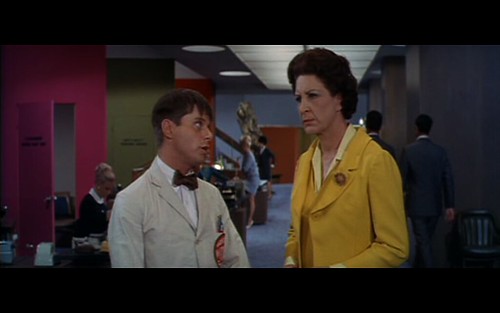
Within five minute, Finch has secured a job in the mailroom without any qualifications. Look, he's wearing the same suit and bow-tie that he wears on Mad Men.
Let's meet the other main characters:
Rudy Vallee (also in the Broadway show) plays J.B. Biggley, the president of the World Wide Wicket Company. He may not be that good at his job, but people still fear him and his favourite expression: "Damn! Damn! Coal burning! Dithering! Ding ding ding..."
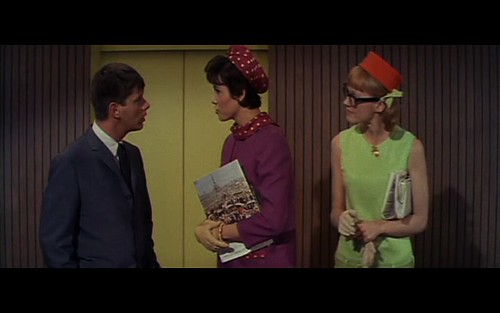
This is Rosemary Pilkington, the secretary who thinks that Finch is a poor little lamb.
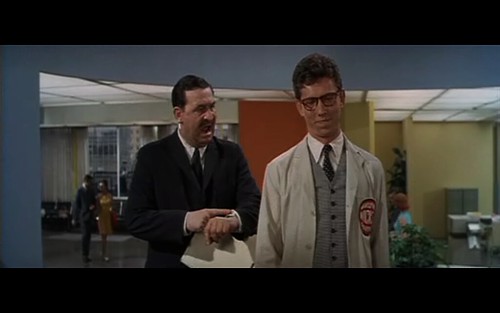
Then there's Bud Frump, Mr. Biggley's scheming nephew who always wears an exact copy of whichever suit his uncle is wearing.
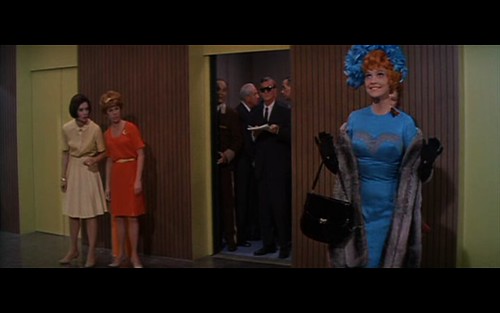
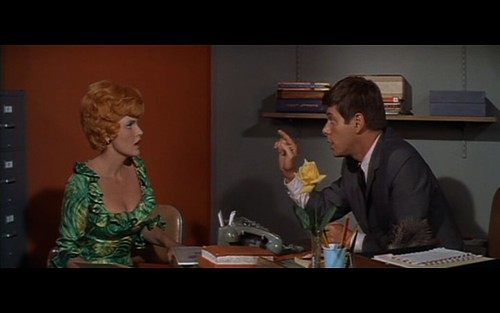
And finally there's the new secretary Hedy Larue, an old family friend of Mr. Biggley's. Would you believe that she used to work in a night club?
Right away in the mailroom, Finch endears himself to his boss and everyone else that he's met so far, except for Bud, who hates him.
He also charms the only hard-working employee, Miss Jones, Mr. Biggley's secretary and within two hours of stepping in through the window,
Finch is made a junior executive. Not bad for a morning's work.
Meanwhile, Rosemary has a scheme of her own. Guess what it is.
I love her hats in the movie, they always match her dresses.
In frustration over having gone a week without a promotion, Finch arranges to bond with Mr. Biggley over their passion for knitting.
By Monday, Finch gets his own office. It may not have a door, but it's a start.
He also gets his own secretary. Hedy can type "like a jackrabbit, twelve words a minute". Fortunately, Finch discovers that Hedy is very good at getting important executives fired.
With one exception, the Vice President in charge of Advertising, which is the job that Finch wants.
With the help of a false moustache and a silly hat, Finch is able deal with that problem.
Check out his new office, is that cool or what? Why, oh why is there not more colour in Mad Men or in any office today.
According to the book, Vice President in charge of Advertising is the worst job to have, because it requires one to have ideas, make presentations and so on, or be fired.
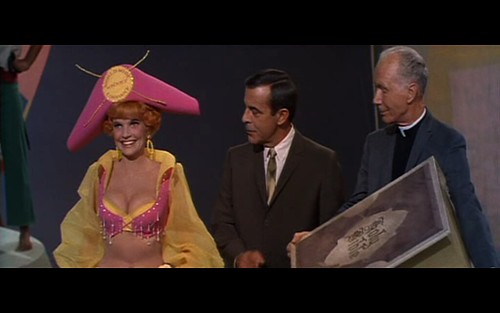
So he comes up with one, but it doesn't go well. Finch's idea includes a televised treasure hunt, a pirate girl and a giant Bible.
This of course leads to the traditional looting mob.
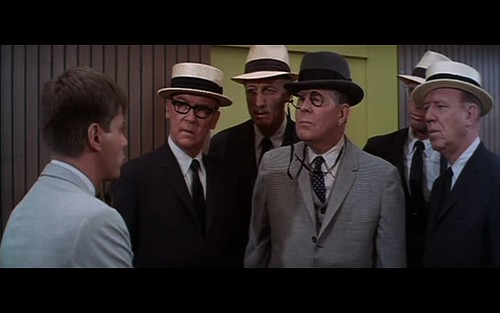
In order to get out of this with his head still attached, Finch has to explain himself to Wally Womper, the Chairman of the Board. Fortunately, Wally also started out as a window washer.
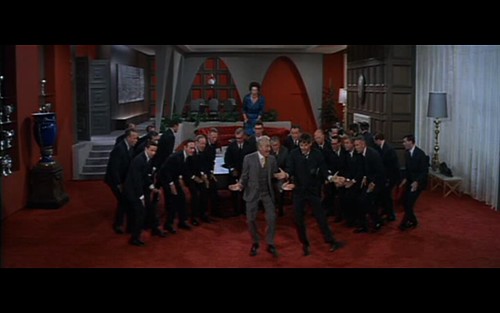
Finch's solution: the big musical number. Does it work?
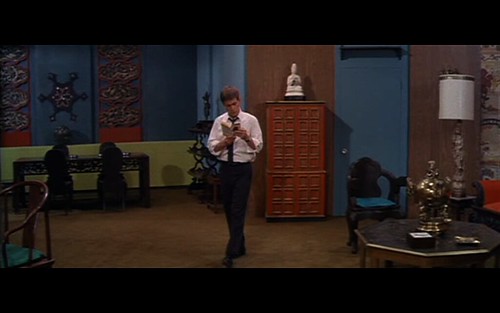
I love Mr. Biggley's presidential office, especially the way the blue vase really sets off the red and brown colour scheme.
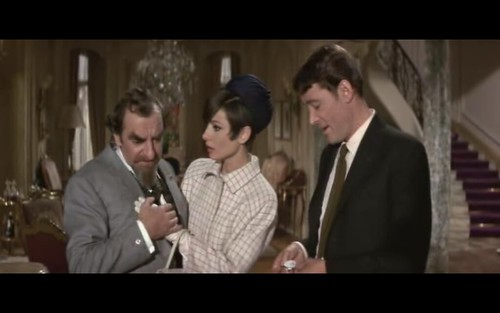

Without wanting to spoil the ending, here are some more shots of the office settings:
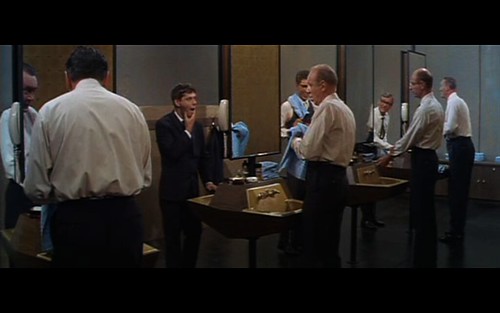
The Executive Washroom. If you can get a key to this room, then you know that you have made it in big business.
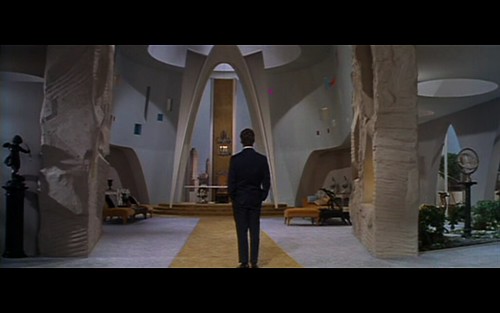
The Chairman of the Board's impressive modern office. I think it's bigger than my house.
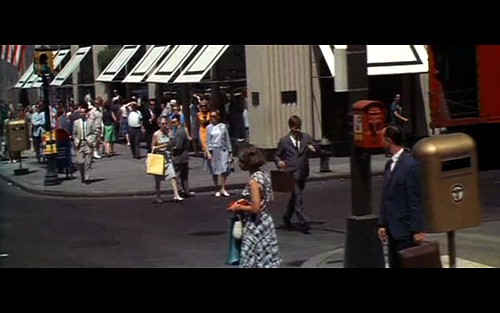
Throughout the film, we often see Finch skipping down the sidewalks of New York. Keep an eye out for the outfits of the people walking down the street, since they weren't extras and several of them stop and stare at Finch's odd way of walking.
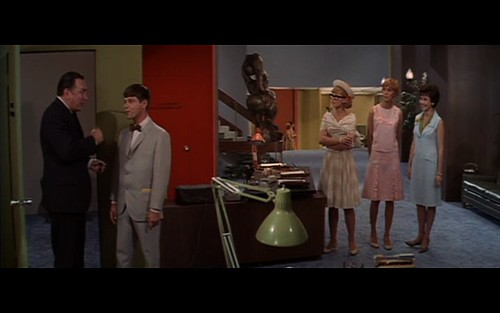
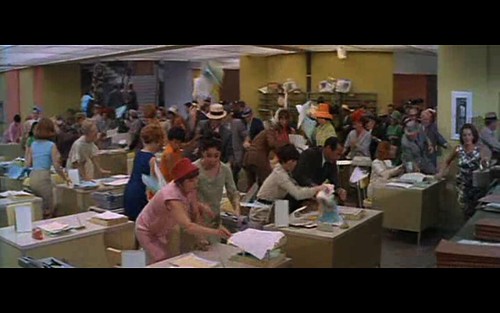
Then of course, there's the secretarial pool in a brightly coloured office setting. They aren't interested in their work, which detracts from the more important things they would be doing.