Thursday, November 12, 2009

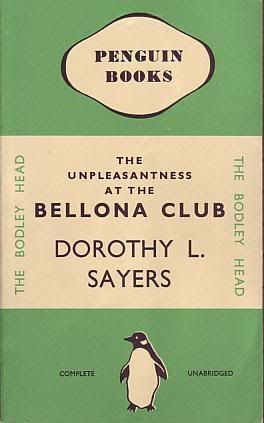
Vintage Novels {The Unpleasantness at the Bellona Club}


The Unpleasantness at the Bellona Club was written in 1928 by Dorothy L. Sayers and is the fourth of the ten novels featuring her detective Lord Peter Winsey (my favourite detective- I shall write a post about him as soon as I've finished writing my term papers).
The story begins on the evening of Remembrance Day with the discovery of the body of General Fentiman in his favourite chair at the Bellona Club, who has been dead for several hours but no one noticed. The problem is that the General's wealthy sister, Lady Dormer, had died that morning at 10:37 and according to her odd will, the bulk of her estate would have passed to the General had he survived her and if not, then the bulk would pass to her distant relative and ward Ann Dorland. Lord Peter, being a member of the Club and known for his powers of deduction, is therefore asked to ascertain which sibling died first in order to resolve the legal difficulties before the affair turns into a public scandal. Naturally he finds that the General had been murdered by someone who knew of Lady Dormer's will.
The novel itself addresses several issues and fads of the day. Sayers' biting wit is largely directed towards Ann Dorland, who is trying to be a bohemian modern artist, but she has neither the personality nor the talent to be successful. Using monkey glands for improving health also pops up several times as does Sayers' critiquing her own genre of detective stories.
What is largely forgotten in literature studies and by mystery fans is Sayers' genuine portrayal of the lasting effects of shell-shock on those who returned. The General's younger grandson, George, is rather badly affected and is unable to hold down a job. Instead his long-suffering wife Shelia has to go out to work, which George is grateful for but is unable to cope with being supported by his wife. As such, Sayers' has preserved the attitudes towards women supporting the household in the interwar period. We can see that those of the General's generation (who fought in the Crimea and Boer wars) view George as being weak and a failure for not fulfilling his expected role, but George's own contemporaries who fought in the Great War are understanding of the situation that George, being permanently disabled, is unable to work and must be supported by his wife as he is too proud to accept hand-outs from Lord Peter (who was also shell-shocked, though not as badly).
I found the novel to be funny in some places, particularly with the portrayals of the older members of the Club, who are most upset that the General died there, rather than having the decency to die at home.
The novel was adapted into 4 BBC episodes in 1972 starring the vastly underrated Ian Carmichael as Lord Peter. I think that the Ian Carmichael adaptations of five of the Wimsey novels are, along with Jeremy Brett as Sherlock Holmes, the best television mysteries around, because they get everything right, from the plot to the characters to the costumes and they're not painful to watch, like it is with whatever ITV is currently doing with it's Agatha Christie adaptations. If you don't have time to read the book, then I would recommend watching the adaptation, which should be available from your local library.
This is the only clip I could find online:

Tuesday, November 10, 2009

Shut the Door, Have a Seat


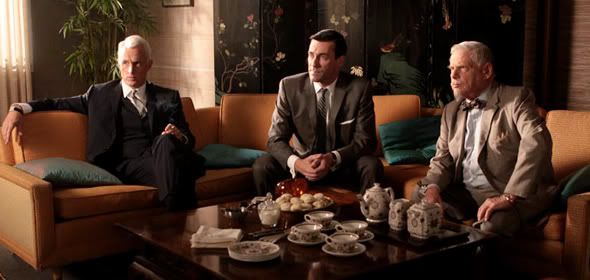
Now that it's over, I have to say that I've been really annoyed with most of season 3 of Mad Men. Mostly because it's becoming increasingly obvious that the people who run the show were not around then and only get their knowledge of the early sixties second-hand and as a result the characters act and react in the stereotyped way that the post-boomer generations expect them to. One can also see that the attention to period detail has been slipping. The backs of the hair styles on all of the male characters younger than Roger are shaggy and uneven, whereas then they would have been cut straight across by the barber, usually every week. And Betty's date dress and hairstyle in Rome would not have been seen until at least 1964. I know that she was experimenting but she would not have worn anything as modern as that dress knowing that she was having dinner with one of Don's most important clients.
I also can't stand how the writers are bringing in today's political correctness in order to point out society's current view that "we're so much better than they were because we have Health and Safety, no afternoon drinking and use Ms. as an address". Which is why we see moments like the dry cleaning bag (which my Grandma says would never have happened), cutting to a shot of someone smoking whenever cancer is mentioned and the foot getting chopped off.
But what I found most annoying this season was that most of the episodes tended to drag on and on without much of anything getting resolved or any character development in anyone really. There are so many questions that didn't get answered like why are Pete and Trudy so happy, why is Peggy sleeping with Duck, what's Paul up to, why is Lois still working there? But the biggest question that did not get addressed is: What's happening with Sal? Why get rid of him just as the gay rights movement is about to start and we would be able to see it through him?
However, the season finale did make up for the previous episodes. At least in season 4 will see the gang back together and doing actual work. Maybe next year, we'll be able to see more of Roger, Peggy, Pete, Harry and Paul and the two Smiths (they have to bring them to the new agency) and maybe less of Don sleeping with yet another brunette and of Betty being a bored angry housewife (that's mostly because I don't think that January Jones can act). I also hope that Roger will dump Jane the alcoholic child and go with Joan, since they do treat each other as equals and Roger has realized that he should have left Mona for her instead. And that Joan will realize that she is good at her career of being in charge of everything, which she will be able to now that the drunk childish failure of a rapist husband is going to die.
Although I'm not at the edge of my seat like I was with the cliff-hanger finale for season 2, I already know that season 4 will be lighter because four months after JFK was killed this happened and everything changed:

Thursday, November 5, 2009

Daily Outfit


Sweater: thrifted
Skirt: thrifted
Belt: thrifted
Collar: vintage
Brooch: vintage

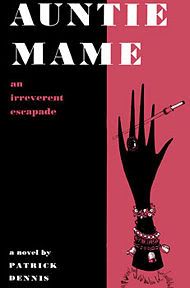
Vintage Novels {Auntie Mame}


"As luck would have it, Auntie Mame, dressed in one of her most exotic outfits, was having stingers with a distinguished Lithuanian rabbi and two dancers from the cast of Blackbirds when Mr. Babcock and I burst into the drawing room."


I love Auntie Mame! It's one of my very favourite novels. I reread it at least once (sometimes twice) a year. It's just so wonderfully hilarious and the author's descriptions of daily life and characters over a span of about thirty years are some of the best written in American Literature. For example "She was built along the lines of a General Electric refrigerator and looked like a cross between Caligula and a cockatoo".

Auntie Mame; An Irreverent Escapade was published in 1955 and was an immediate hit, staying on the New York Times best seller list for over two years. It was then adapted into an equally successful Broadway play starring the always fabulous Rosalind Russell, who reprised her role in the film version that was released in December 1958 and became the highest grossing film of 1959. A paperback edition was finally re-released in 2001 by Broadway Books along with its 1958 best selling sequel Around the World with Auntie Mame (dedicated by the author to Rosalind Russell).

Auntie Mame tells the story of a 10 year old orphan named Patrick who is sent to live with his father's eccentric sister Mame Dennis in 1928. The book is told by an adult Patrick looking back on his madcap adventures with his aunt, after being prompted by a memoir in Reader's Digest about a foundling being raised by a rather dull spinster. We first meet Auntie Mame when she is in her Japanese phase before becoming (among other things) a decorator, Southern belle, Anglo-Irish writer, society matriarch, failed actress before ending in her Indian phase. Patrick never complains about the unconventional way in which his aunt raised him, such as sending him to a co-ed school for naked children for a few weeks. But he does rebel after graduating university by getting engaged to Gloria Upson, who's all blonde, Connecticut, tennis and has a friend named Bunny (definitely not from the right sort of people). Naturally Auntie Mame has to prevent the marriage from happening in the funniest chapter of the book.
What the author does brilliantly is to describe every outfit that Auntie Mame wears and in what context she wears them in. Since she changes her style every 15 minutes, we get a record in prose form of the changing styles of the vintage era and the care in which she selects her outfits in accordance to where she is going and who she is meeting. We also have Auntie Mame's best friend and stage star Vera Charles (the archetype of the Heroine's Alcoholic Best Friend) offering this advice on what to wear to meet Patrick's very conservative trustee: "A grey day, a grey mood, a grey dress with perhaps just a suggestion of sables".

Here's the trailer and a scene from the beginning of the film. As far as adaptations go it's excellent, maintaining as much as possible from the book that the censors would allow and changing a few aspects in order to make the plot run smoother.


Wednesday, November 4, 2009

Vintage Novels


I have noticed that the vintage revival movement has been sorely lagging in reviving popular novels of the period. I've always read vintage novels and have never really gotten into reading modern novels. I think the last modern novel that I've read for fun was The Liar by Stephen Fry (I've been meaning to get around to reading his other novels) and that was a couple of years ago.
Therefore, I'm going to do a weekly post on Thursdays of a vintage novel (or novella) and include how it was received when it came out and review any adaptations made of it.
My first selection will be up tomorrow, sometime in the late afternoon.

The Queen of Taps


Out of cinema's three best solo tap dancers (in terms of innovation, creativity and high degree of expertise) only Eleanor Powell remains largely forgotten, despite being heavily featured in That's Dancing and all three parts of That's Entertainment.
The only reason I can find for this is that there are no books about her, few of her films are on DVD and TCM rarely shows them (Born To Dance was on yesterday and the next showing of one of her films is not until the middle of January).
Although she only made a handful of films before retiring and moving into a nightclub act after divorcing Glenn Ford, she was the only female tap dancer to have the starring part and for the plot to be based around her dances.
Even though it's been said that Ginger Rogers did everything backwards and in heels, Miss Powell did choreograph most of her dances and they usually featured a skill feature, such as rope, Morse code or this dog (which she trained herself):


I love watching her films because you can see the level of work that she put into making them look effortless. And also because she is often costumed in the best examples of late 1930's sport fashions. The plots may be similar but like all musicals you know that the choreography will be different and everything always turns out right in the end. And one of her costars was the young Jimmy Stewart who sang (with a fair voice) several songs.
This is the Fascinatin' Rhythm number, which you might remember from the behind the scenes footage shown in That's Entertainment 3


Although she never danced with Gene Kelly, she is the only dancing partner of Mr Astaire who was able to out dance him, not by much but he is occasionally slightly off the beat.


I would love to see a biography of her to come out and for her talents to be rediscovered, but until then I can make do with the good selection of her dances on YouTube.
This is the long version of the Begin the Beguine number (the short, quality versions keep getting taken down) from Broadway Melody of 1940. Skip to the 6:09 mark and you'll see the best tap dance ever filmed.

Tuesday, November 3, 2009

Daily Outfit


I have to start taking photos in the morning, I always forget how early it becomes dark.
Does anyone else think that Betty is going to leave Don for Henry next Sunday?

Blouse: thrifted
Skirt: thrifted
Scarf: vintage (too cold to take a close up)
Belt: Jacob
Shoes: Kenzie